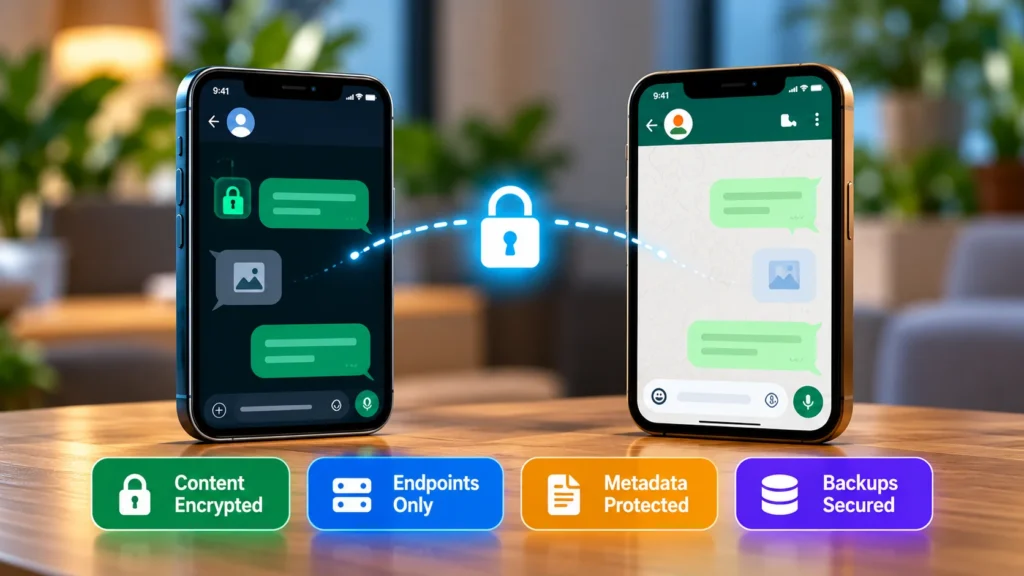
End-to-end encryption, often shortened to E2EE, protects communication content so that it can be read at the intended endpoints rather than by the service carrying it between them. In a messaging example, those endpoints are the devices used by the sender and intended recipients.
That is valuable protection, but its boundary matters. A message can be protected while crossing the internet and still be exposed on an unlocked phone, copied by a recipient, or included in a backup with different protections. E2EE is one part of the privacy picture.
What is end-to-end encryption doing?
Encryption turns readable information into an encoded form that requires the appropriate key to recover. NIST’s encryption glossary describes this distinction between usable data and ciphertext.
For an end-to-end encrypted conversation, the content is encrypted before the intermediary handles it and becomes readable at the intended receiving endpoint. The service can deliver the encrypted material without needing the keys that let it read that content. The exact key-management arrangements depend on the implementation.
Think of sending a private family update. The important claim is about who can decrypt that update, not simply whether a lock symbol appears somewhere in the app. Check that the particular conversation or feature is covered; a service can offer several communication modes with different protections.
Three uses of “encrypted” that are different
Encryption in transit protects information while it travels over a connection. A secure website connection can protect your traffic between the browser and the website, while the website still receives readable information to process.
End-to-end encryption carries the content protection across the intermediary to the receiving endpoint. An intermediary being unable to decrypt the content is the distinction readers should look for.
Encrypted storage protects saved information. Its practical protection depends partly on who holds or can obtain the decryption keys. A provider-managed encrypted copy is not automatically equivalent to an end-to-end encrypted backup controlled by the user.
These protections can coexist. An app may use encrypted transport, E2EE for personal messages, and a separate backup system. The broad statement “our data is encrypted” does not explain all three.
What it can help protect against
Properly implemented E2EE helps protect covered message content from being read by network intermediaries or someone intercepting the encrypted traffic. It also limits the message content available to the delivery service through its normal handling of that encrypted conversation.
CISA’s mobile communications guidance recommends end-to-end encrypted messaging as a protection against communications interception. That guidance was written especially for highly targeted people; its existence does not mean every ordinary reader faces the same threat.
The practical recommendation is to choose a trustworthy service with clear documentation, keep its software current, and understand which features are protected. Encryption does not compensate for installing an untrustworthy app that misrepresents what it does.
Message content is different from metadata
Even when the words are protected, other information may remain available. Depending on the service and network, this can include account identifiers, connection IP addresses, device information, timestamps, delivery details, or information about who communicates with whom.
NIST’s end-to-end encryption definition explicitly distinguishes encrypted data from visible routing information. Different services try to reduce different categories of metadata; E2EE alone does not promise anonymity.
Signal’s technical discussion of reducing sender metadata illustrates that this requires additional design work. It is an implementation example, not a reason to assume every encrypted messenger hides the same things. Review what apps may collect separately from their message-encryption claims.
A VPN addresses another layer of the connection. Understanding what a VPN actually changes helps avoid treating it as a replacement for message encryption or an anonymity guarantee.
The endpoints can still reveal the conversation
The receiving app must make a message readable for its user. Someone using that unlocked device may therefore be able to read it. Malware with sufficient access, exposed notification previews, or a shared computer can create problems outside the encrypted journey.
Recipients also control their own behavior. They can describe a message to someone else, photograph a screen, or forward information where the app permits it. Disappearing-message features should not be treated as a promise that nobody can retain a copy.
For a sensitive conversation, consider both the channel and the recipient. Send only the information needed, check who is included, and avoid assuming that encryption makes another person’s handling of the content trustworthy.
Backups, groups, and linked devices need separate checks
A backup can preserve a conversation outside its original live-message path. Check whether backup encryption is enabled, who can unlock it, and what recovery requires. Do not infer those answers from the protection of messages sent today.
WhatsApp, for example, documents separate end-to-end encrypted backup options, including a passkey-based option announced as a rollout. Availability and recovery choices should be checked in the installed app. This illustrates why backup settings deserve their own review.
In a group chat, the authorized recipients include the group’s participants. Additional linked devices can create more endpoints at which information is accessible. Review membership and your own linked sessions before discussing confidential matters; implementation details vary between services.
Verification codes check the connection, not someone’s character
Some messengers provide security codes or safety numbers to compare with a contact. Use the app’s documented method, preferably checking through a separate trusted route or in person for a sensitive conversation.
Signal’s safety-number guidance explains what verification covers and warns that it does not establish a person’s identity by itself. A changed number may follow a legitimate device change; unexpected changes deserve investigation rather than an automatic accusation.
Do not confuse conversation-verification values with account registration codes. Registration codes and recovery credentials are secrets that should not be sent to someone claiming to provide support.
Keep account protection and link judgment separate
An encrypted message can contain a fraudulent payment request or a phishing link. The encryption protects delivery of the message; it does not certify the destination. If a request seems unusual, verify it independently and inspect signs of a fake login page before entering credentials.
Account takeover is also a separate problem. Review available two-factor authentication and recovery methods, keep devices locked, and remove unfamiliar sessions. A service’s encryption label cannot tell you whether the person currently operating an account is its rightful owner.
The useful question is what the protection covers: this content, in this conversation, between these endpoints. Then check the devices, backup arrangements, and account access around it.